Written By Rahul Kumar
Published on August 13, 2022
Last updated on January 22, 2026 • 8 min read
A deal, advertisement, or marketing can only be successful when your customers understand the message. You need to write product descriptions in a simple and attractive way so that when a customer comes to your product page, the message will resonate with them and they will consider buying it. Thus, you need eCommerce product descriptions that will communicate with visitors and answer frequently asked questions related to your product.
Providing good product descriptions should be just as important as the quality of your website or the quality of your product’s images. Not only does it enhance the online consumer experience, but it also adds credibility to your business, raises the ranking of your online store, and increases the number of people that convert to your website. Let us look at the best strategies to attract customers to your online business with persuasive product descriptions.
A product description is a marketing paragraph that describes a product’s features and benefits and emphasizes its unique selling proposition (USP). A product description’s main goal is to persuade people to buy the product by giving them all the important details about its qualities and advantages of it.
However, creating product descriptions that merely explain your products as a supplement to product pictures is a common mistake that occurs frequently. This mistake can be made by business owners, marketers, and even expert copywriters. A solid product description not only sells your products to actual customers but also provides additional optimization for search engines.
WareIQ, an eCommerce fulfillment company, empowers online brands with a superior-tech platform to compete with Amazon like service levels by bringing their average delivery timelines from 5-10 days to 1-2 days.
Are you aware that your SEO could be impacted by your product reviews? Your product reviews may wind up showing up in Google searches, particularly in Google Shopping, if you use review services. They can significantly boost website visitors. Effective product descriptions can increase conversions, establish your brand image, increase credibility and enhance the SEO capabilities of your website. To understand this point, imagine how absurd it would look if a product listing has no product description examples. A buyer will have doubts about the authenticity of the product as well as the availability. Product details help buyers in the following ways:
Suggested Article: How to Effectively Start an Online Business?
We become passionate about certain product features and specs when we market our own products. We are completely devoted to our business, website and offerings. The issue is that our prospective customers are not as interested in unimportant features and specifications. They want to know how it will satisfy their demands and what benefits they can expect. You must therefore emphasize the advantages of each feature. Sell an experience rather than a product.
When you write eCommerce product descriptions with a large number of potential customers in mind, your descriptions end up being vague and addressing no one in particular. The finest product descriptions speak immediately and personally to your target market. You converse with them by posing questions and providing answers in this way. Address them directly with words like “you”.
Start by picturing your ideal customer while creating your own product descriptions. What sort of trend do they find enjoyable? What phrases do they use? What phrases irritate them? Do they accept phrases like “sucky” and “crappy”? What inquiries do they make that you ought to respond to? Think about how you would communicate with your ideal customer if you were selling your goods in person in a store. Try incorporating that language into your eCommerce site so you can have a more meaningful dialogue of that nature there.
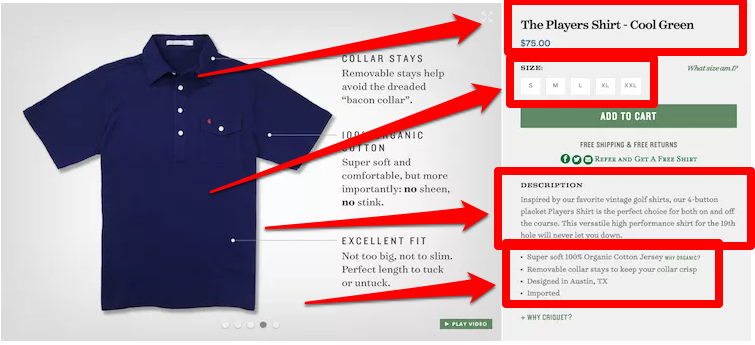
In general, lengthy product descriptions are not required. The product description examples that you can use depend on the type of product you are describing and the list of features that it has. However, you should generally try to keep product descriptions concise and simple to read. This is where bullet points can be quite helpful.
The facts about the material, available colours and size options are some of the significant features that can be noted in bullet points. Keep in mind that users may occasionally only read the bullet points and ignore the rest of the description. It is crucial to draw attention to the most significant qualities and advantages in your product descriptions.
According to scientific studies, holding a product in your hands makes you want to buy it more. Since you’re selling online, your customers can’t physically see or hold your goods. Additionally, there is a copywriting technique to increase desire – have your reader visualize what it would be like to own your goods. This can be done by using large, clear photographs or exciting language. Start your paragraph with the word “imagine” to use this copywriting strategy and then describe how you imagine the reader would feel after purchasing and using your product.
Think about if there is any relatable backstory of your product that holds any special meaning for you before writing your product descriptions. There’s a good chance that your audience will find it to be especially unique, lovable, and memorable. Use that tale in your eCommerce product descriptions to give it more personality, draw customers in and win them over.
You can convincingly demonstrate why your product is the best, simplest or most sophisticated by using superlatives and powerful words. As Amazon explains, “the Kindle Paperwhite is the most sophisticated, patented e-reader in the world”. The reader gets the impression that this is something remarkable because of the phrase “patented.” Going along with product description examples like this, Amazon claims that “Paperwhite boasts higher contrast and spectacular resolution” and Amazon goes on to provide various percentages to support this claim, as well as one crucial benefit: “Paperwhite provides glare-free, clear, crisp text and images even in direct sunshine.”
Never boast about your product or give wrong information. It may skyrocket your product sales for a while but it will never work in the long term and can ruin your brand reputation and generate negative feedback from unhappy customers. Always try to give facts and figures to support what is mentioned in the product description examples. Numbers in bullet points always appear immediately on the first look and make a mark on the viewer.
When the product description has a clean, scannable design, your product descriptions will be easier to read and be more appealing to potential customers. When creating your product description, consider the following areas:
It is crucial to keep your keywords in mind, even though this will probably happen naturally if you create a decent product description. Using the appropriate keywords will assist your sites to move up in the search results from the perspective of search engine optimization (SEO). In addition to enhancing trustworthiness, gathering and showing customer feedback has SEO advantages for your product pages. Consider that easily searchable keywords from an SEO standpoint will have a huge positive impact on your page. The main advantages are:
The greatest approach to describe your goods isn’t usually through text. Consider how you can simplify your writing if it starts to grow overly wordy. Customers are more likely to retain information when it comes to visual representations. If at all feasible, showcase your product in a visual way that demonstrates how it works. Even though they typically lack words, images do provide answers to customer questions. Include as many details about the many applications and perspectives of your product as you can in the pictures. Keeping this in mind, take care that the quality of the image of the video is good otherwise it will reflect poorly on your business.
The above advice will help you create eCommerce product descriptions that encourage customers to buy from your eCommerce company. Connecting with customers through language and imagery when they are unable to physically connect with your products can make the difference between them just browsing online and actually completing a purchase. If you need assistance with fulfilling orders that are the result of enhancing your product descriptions, consider partnering with WareIQ.
WareIQ integrates with multiple selling applications through our custom WMS Software such as Amazon, Flipkart, eBay and more, and also has facilities such as a nationwide network of fulfillment centers, a custom app store, partnerships with more than 20 shipping carriers, and more. Your customers can keep up to date with their orders through our branded tracking pages and you can check on your inventory through real-time updates.
Trusted by 300+ top Indian brands, we are helping them accelerate online sales and expedite their growth through a synergistic combination of advanced technology, robust fulfillment infrastructure & seller enablement services!WareIQ is backed by leading global investors including Y Combinator, Funders Club, Flexport, Pioneer Fund, Soma Capital, and Emles Venture Partner.
Create an overview of what your company does first. Then, describe your justification for selecting this market, including any favourable market trends, fewer taxes or a lack of competition.
Customer decision-making is aided by product descriptions as it would be foolish to simply display products and their prices without providing the customer with any information about them. They also help your website look professional.
A product description is a marketing phrase that is used to describe and clarify the advantages of your product. In other words, it displays all of your product’s information and specifications on your eCommerce site. This product information may consist of a single sentence, a brief paragraph or bullet points. They may be sombre, humorous, or eccentric.
Supercharge your fulfilment with WareIQ now, contact our team.
Rahul Kumar worked as a content marketing analyst at WareIQ contributing to blog posts related to eCommerce operations, fulfillment and shipping along with a few topics around tips and tricks for eCommerce sellers. He has more than 3 years of content writing experience across industries like logistics & supply chain, media etc.
Read all of Rahul Kumar's Posts
When most brands think about Indian marketplaces, the conversation starts and ends with Amazon and Flipkart. That is an increasingly costly blind spot.Meesho Mall, the branded sub-platform within Meesho, saw a 117% increase in orders in 2024 Business of Fashion, making it one of the fastest-growing branded commerce channels in the country. The platform is not a niche experiment anymore. Meesho Mall has partnered with over 400 national and regional brands including Bajaj, boAt, Biotique, Decathlon, Bewakoof, and Himalaya Business of Fashion, and FMCG majors like Hindustan Unilever, Procter and Gamble India, and Himalaya have joined to expand their personal care presence on the platform.If your brand is not on Meesho Mall yet, this guide will tell you exactly why that should change, and what fulfillment discipline you need to succeed there.For brands evaluating new growth channels, Meesho Mall is quickly becoming a strategic priority rather than an optional experiment. Understanding how Meesho Mall for Brands works can unlock scalable, cost-efficient expansion in India’s evolving ecommerce landscape.What is Meesho Mall?Meesho started as a marketplace for unbranded, value-segment products — factory-direct fashion, home goods, and accessories sold by small suppliers across India. It built an enormous user base in the process. In 2024, Meesho reached 187 million annual transacting users, making it India's largest e-commerce platform by this metric, with 400,000+ active sellers and rising order volumes from Tier 2 and smaller cities.Meesho Mall is a sub-platform within Meesho for branded products, modeled on approaches taken by Taobao and Shopee — both of which launched separate branded tiers (Tmall and Shopee Mall) alongside their core marketplaces. The logic is the same: use the massive Meesho user base as the funnel, then offer brands a dedicated, verified lane within it.Meesho Mall has been growing at approximately 30% month-on-month since launch and processed over one crore orders in its first six months of active operation.Why Brands Should Sell on Meesho Mall1. Access to a buyer segment Amazon and Flipkart don't fully serveMeesho's core strength is Tier 2, Tier 3, and rural India. Meesho reaches customers across 19,000+ pin codes Rekonsile, with a large proportion of buyers in cities and towns where Amazon and Flipkart have lower penetration and higher delivery costs. For brands in personal care, footwear, apparel, and home essentials, this is not a secondary market — it is the next 100 million buyers.About 65% of Meesho's customers are women, higher than the overall percentage of women who shop online nationally at 47% Business of Fashion — a demographic that overlaps directly with the buyer profile for beauty, personal care, fashion, and home categories.2. The demand for branded products on Meesho is provenMeesho identified through user research that there were repeated searches for branded products in categories like personal care, beauty, footwear, and electronic accessories — and Meesho Mall was launched specifically in response to that signal. Business Standard The demand exists on the platform. Brands that list early capture that search intent before the competitive density on the channel increases.3. Zero commission keeps your margins intactMeesho does not charge commission fees from sellers. WareIQ Compared to Amazon's category-level commission rates — which can run from 5% to 15% depending on the category — this is a structurally different economics model. The trade-off is that Meesho charges for shipping, but the net landed cost for many categories is still favorable.Registering on the Meesho Seller Panel A Complete Guide for Suppliers [2026]4. Meesho Mall signals brand legitimacy to platform buyersBeing listed under Meesho Mall, rather than as a generic Meesho supplier, signals authenticity. Meesho enforces brand verification, sellers who cannot produce a trademark certificate or brand authorization document to verify product authenticity will lose the M-Trusted tag and face listing restrictions. Meesho For brands, this verification requirement works in your favor: it reduces counterfeit competition and positions your listings as trustworthy.5. Monetization potential is growingMeesho's CFO Dhiresh Bansal has stated that Meesho Mall is expected to be a significant lever for monetization going forward, with the focus on accessibility, affordability, selection, and experience for all stakeholders. Business Standard As the platform builds out its ad tools and analytics for Mall sellers, the channel will increasingly offer the kind of brand visibility mechanics that Amazon and Flipkart sellers use today.Which Brand Categories Are Best PositionedNot every brand will find the same traction on Meesho Mall. Based on current category data and growth patterns, the strongest fits are:Personal care and beauty, personal care and beauty accounts for approximately 10% of Meesho's total business, and it is a category where branded product searches are consistently high. Business of Fashion Brands in this space have seen strong order growth on Mall.Footwear — Indian value footwear brands like Liberty, Action, and Paragon are active on the platform Business of Fashion, and the category benefits from Meesho's Tier 2 reach where physical retail is fragmented.Apparel and fashion fashion contributes about 55% of Meesho's total business Business of Fashion, and mass-market brands in this space have a built-in audience.Home and kitchen — home and kitchen essentials contribute about 20% of Meesho's business Business of Fashion, making it a significant category for brands in that space.Electronics accessories higher branded intent in this category makes it a natural fit for Mall's brand-verified lane.What Fulfillment Looks Like on Meesho MallGetting on Meesho Mall is one thing. Performing well there is another. Meesho's algorithm rewards sellers who dispatch on time, maintain low return rates, and keep order quality high. Here is what you need to know operationally.Dispatch SLAOrders must be shipped within 2 to 3 days from the date of receiving the order within the agreed SLA window. Sellers can check order status and days remaining for dispatch on the Meesho Supplier Panel.For brands running self-fulfillment from a single warehouse, this SLA is manageable at low volumes. As order volumes scale especially during sale events maintaining this window becomes the primary operational challenge.Next Day Dispatch (NDD) ProgramThe Next Day Dispatch program supports faster shipping timelines for eligible sellers and provides access to a dedicated account manager. Meesho Joining NDD is a meaningful visibility booster. Products eligible for the NDD program can see up to a 12% increase in customer interest.To qualify for NDD, your warehouse operations need to be able to pick, pack, and hand off to the logistics partner same-day on order receipt. That requires either in-house operational discipline or a fulfillment partner with the infrastructure to execute it reliably.Returns and RTOCustomers can return products within 7 days of delivery. Shipments that are not delivered to the customer are converted to RTO (Return to Origin) and sent back to the seller.High RTO rates common in Tier 2 markets due to cash-on-delivery preferences and address accuracy issues will erode your margins if not managed proactively. Good fulfillment operations flag high-RTO pin codes and route orders accordingly.Get 100% Approval on Marketplaces Claims with Our Returns QC SolutionPackaging requirementsProducts must be packed in plain packaging material with no branding. Meesho does not provide packaging material. This is an important operational note for brands used to branded packaging you will need to adjust your packing workflow or maintain separate unbranded packaging stock for Meesho fulfillment.PaymentsPayments are processed every seven days post-delivery. Sellers can view detailed payment reports on the Supplier Panel to track earnings and understand any deductions, such as return adjustments.Explore - How to Sell on Meesho: Step-by-Step Seller Guide [2026]How WareIQ Helps Brands Fulfill on Meesho MallRunning Meesho Mall fulfillment out of a single city warehouse works until volumes grow. The challenge with Meesho is that its order demand is geographically distributed, a significant share comes from Tier 2 and Tier 3 locations spread across the country. Shipping from a single hub means longer transit times, higher freight costs, and elevated RTO rates.WareIQ's distributed fulfillment network across 13+ cities solves exactly this problem. When your inventory is positioned closer to where Meesho's orders originate, you ship faster, qualify for NDD more reliably, and reduce the cost and friction of failed deliveries.Beyond the network, WareIQ's tech stack integrates directly with Meesho, giving you real-time order sync, automated shipping label generation, returns tracking, and inventory visibility across all your fulfillment centers, all in one dashboard. You manage Meesho alongside Amazon, Flipkart, your D2C store, and any other channel from a single interface, without the operational overhead of running separate fulfillment processes for each.Explore - WareIQ's Amazon-Like Seller Panel for Multi-vendor MarketplacesFulfillment Services for Fastest DeliveryIf you are planning your Meesho Mall launch or looking to improve your current Meesho fulfillment performance, talk to the WareIQ team.Frequently Asked QuestionsWhat is Meesho Mall?Meesho Mall is a dedicated branded products section within the Meesho marketplace. It operates as a verified lane for established brands, separate from Meesho's general supplier marketplace.Is Meesho Mall free to join?Meesho does not charge a commission on sales. Sellers pay for shipping costs. There are no listing fees.What documents do I need to sell on Meesho Mall as a brand?You need a valid GSTIN, bank account details, and brand authorization documents or a trademark certificate to verify product authenticity and qualify for the M-Trusted tag.What is the dispatch SLA on Meesho?The standard SLA is 2 to 3 days from order receipt. Brands on the Next Day Dispatch program ship within 24 hours and receive improved visibility on the platform.Can WareIQ handle Meesho Mall fulfillment?Can WareIQ handle Meesho Mall fulfillment? Yes. WareIQ integrates directly with Meesho for order sync, label generation, and returns management. Our distributed fulfillment centers help brands meet NDD requirements and reduce RTO rates across India.
March 26, 2026
The world is fast evolving, and customers expect fast delivery, accurate orders, and smooth service. And for growing companies, managing storage, packaging, and shipping in-house can become stressful and expensive. It is where contract logistics can play an important role. Logistics is not only about moving a product from one place to another; it is the heartbeat of your customer's experience, and contract logistics can make a real difference. In fact, the global contract logistics market is expected to reach a staggering $503.3 billion by 2030. So, opting for contract logistics is definitely a value-add and the best decision a business can make. In this guide, we are going to explore the meaning of contract logistics, its benefits, real-world use cases, and how it is different from 3PL.Exploring the Basics: What are Contract Logistics Services?Contract logistics refers to a long-term agreement between a business and a logistics service provider. Under this contract, the provider manages storage, transportation, inventory management, packaging, and order fulfilment. It means outsourcing your logistics work to experts through a fixed contract. The services that a business can avail via contract logistics usually include:Inventory management and real-time tracking.Product assembly and custom packaging.Quality control inspections before shipping.Reverse logistics involves managing returns and repairs.Unlike short-term delivery services, 3pl contract logistics focuses on building a long-term partnership.How Does Contract Logistics Work?When a business partners with a contract logistics provider, both parties sign an agreement. This agreement outlines services, pricing, timelines, and performance standards. To ensure better clarity and transparency, a 3pl logistics contract template is often used. Here is how contract logistics works step-by-step:Step 1: Understanding business needsStep 2: Designing a custom logistics planStep 3: Setting up warehousesStep 4: Integrating software systemsStep 5: Managing daily operationsStep 6: Tracking performanceDifference Between Contract Logistics and 3PLOne of the most common sources of confusion for business owners is the distinction between contract logistics and 3PL. While they are related, they are not identical.Here is the difference between contract logistics and 3pl:FeatureContract Logistics3PLDurationLong-termShort or medium-termCustomisationHighLimitedRelationshipStrategic partnershipService-basedFlexibilityTailored to businessStandard packagesInvestmentHigh commitmentLower commitmentKey Benefits of Contract Logistics for Growing BusinessesManaging a supply chain in-house can be a full-time job that pulls you away from your actual business. As the business scales up, the complexity of moving goods increases exponentially. It is where businesses today are moving to contract logistics, as it provides the professional backbone needed to scale without the stress of managing a warehouse.There are several other benefits of contract logistics, such as:1. Cost Control and Better BudgetingManaging warehouses and transport internally can be expensive. However, with contract logistics, businesses pay only for the services they use. Thus, it drastically improves financial planning and stability by:Reducing infrastructure costsAvoiding staff expensesLowering equipment investmentPredicting monthly spending2. Focus on Core Business ActivitiesRunning logistics takes time and energy. It can impact a business's overall efficiency. By hiring a contract logistics provider, businesses can turn their focus to:Product developmentMarketingCustomer serviceSales growth3. Better Customer ExperienceFast and accurate delivery builds customer trust. Satisfied customers are more likely to return. Professional contract logistics services ensure: Delivery being on-timeAccurate packagingReal-time trackingEasy returns4. Access to Technology and ExpertiseWhether you run a large business or a small enterprise, you can benefit from the same technologies used by top contract logistics companies in India, without heavy investment. Such technology includes:Warehouse Management Systems (WMS)Inventory tracking softwareAI-based demand forecastingRoute optimisation systems5. Scalable OperationsAs your business grows, so will the order volume. Handling this growth alone can be difficult. Contract logistics offers the business flexibility to support expansion. So, business can easily:Expand warehouse spaceAdd delivery routesIncrease the workforce whenever requiredManage changing seasonal demandRelated - Types of Logistics: A Guide to Modern Supply ChainsMajor Use Cases of Contract LogisticsBefore understanding how contract logistics supports different industries, it is helpful to see where it is used in real business situations. Whether it is online stores, fashion, or retail, they rely on professional logistics partners to manage storage, transport, and fulfilment.Here are the major use cases of contract logistics and its benefits:Industry / SectorBusiness NeedHow Contract Logistics HelpsKey BenefitsE-commerceHigh order volumes, fast delivery, easy returnsManages warehousing, order fulfilment, last-mile delivery, and reverse logisticsFaster shipping, better customer satisfaction, lower costsManufacturingRaw material storage and product distributionHandles inbound logistics, inventory control, and nationwide distributionReduced downtime, smooth production flowRetailRegular stock replenishment and inventory controlOperates regional warehouses and manages store deliveriesFewer stock-outs, which helps to improve shelf availabilityPharmaceuticals & HealthcareTemperature control and regulatory complianceProvides cold storage, secure transport, and quality monitoringProduct safety, legal complianceFMCG & FoodRapid movement of perishable goodsOffers cold chain logistics and quick distributionReduced waste, longer shelf lifeAutomotiveParts storage and just-in-time deliveryManages spare parts warehouses and plant supplyLower inventory cost, faster production cyclesElectronics & TechnologySecure handling and fast distributionProvides anti-static storage and protected transportLower damage rates, improved delivery speedFashion & ApparelSeasonal demand and high SKU volumeManages sorting, packaging, and returnsBetter inventory turnover, fewer unsold stocksB2B WholesaleBulk movement and dealer supplyHandles bulk storage and scheduled dispatchCost savings, reliable supply chainChemicals & Industrial GoodsSafety and compliance requirementsEnsures hazardous material handling and documentationRisk reduction, regulatory complianceScale Smarter and Grow Faster with Contract Logistics Services by WareIQWareIQ is a Y-Combinator-backed eCommerce full-stack platform offering multi-channel fulfillment across D2C, Marketplaces, Quick Commerce, and B2B (General Trade & Modern Trade)Our solution offers:Pan-India network of Seller Flex & FAssured compliant across 12+ cities operated by WareIQ, and shipping partners for last-mile delivery across 27000+ pin codesMulti-Channel Fulfilment Platform with plug-and-play integrations across marketplaces (Amazon, Flipkart, Myntra, Nykaa, etc.), D2C platforms (Shopify, Magento, WooCommerce, etc.), WMS, and ERPs, to support fulfilment across distributors, flagship stores, and eCommerce channels with analytics capabilities to assess operational performanceInventory LogIQ: AI-led multi-channel inventory planning solution to minimise stockouts and automate replenishmentLeverage Tech-enabled returns QC solution to capture, centrally store, and auto-index HD media evidence of damaged or missing returned products and eliminate marketplace claims rejections.A host of seller enablement and support - dedicated account manager, APOB/PPOB registrations, GST registration, NDR & COD verification, etc.ConclusionContract logistics has become a necessity for businesses, as speed, accuracy, and reliability define success in a world where time is of the essence. It helps growing brands stay agile, control costs, and deliver consistent customer experiences without operational stress.By outsourcing warehousing, fulfilment, and delivery to experts through a contract logistics service provider, businesses can reduce operational pressure, control costs, and focus more on innovation and customer engagement.Also check -Customer Service in Logistics: Importance and Best PracticesFrequently Asked QuestionsWhat is contract logistics?Contract logistics is a long-term partnership where a logistics provider manages warehousing, inventory, fulfilment, and transportation for a business. It helps companies outsource complex supply chain tasks and focus on growth.How is contract logistics different from 3PL?The main difference between contract logistics and 3PL is the duration and level of customisation. Contract logistics focuses on long-term, tailored solutions, while 3PL usually offers standard, short-term services.How does contract logistics improve customer service?It ensures faster deliveries, accurate orders, and better packaging. This aims to improve customer satisfaction and build long-term trust.What is the role of technology in contract logistics?Technology in contract logistics helps to track inventory, manage orders, as well as optimise routes. Tools like WMS and ERP systems improve accuracy and efficiency.
March 06, 2026
Customer service is an aspect of your business that should never be taken lightly, as about 86% customers stop buying from a brand after just two poor delivery experiences. Today, one late parcel or one unanswered complaint can not only push a customer away but also drive them directly to your competitor. This is why customer service in logistics is no longer only about moving goods. It is more about building trust, loyalty, and long-term relationships so that customers keep coming back. Whether it's a large brand or a small e-commerce website, customers want fast delivery, live tracking, and helpful support. Businesses that fail to invest in strong customer service can drastically fall behind.Today, we will explain the importance of customer service in logistics, its key elements, and the best practices that help logistics companies succeed.The New Face of Logistics: More Than Just DeliveryGone are the days when logistics only meant transporting goods from one location to another. Today, it is about creating a whole experience for the customer. Customer service in logistics management covers everything from order placement to final delivery and post-sales support. Customers now expect instant tracking, live updates, quick responses, easy returns, and honest communication. Strong customer service in a logistics company focuses not only on the package but primarily on people. Why Customer Experience Is the Real Competitive Edge?In a marketplace, most companies offer similar prices, delivery speeds, and routes. What sets one company apart from another is the quality of its customer experience. So, customer service in logistics has become the strongest competitive advantage.It is no longer only about how soon the package will arrive; it is also about how the company communicates, how quickly it solves problems, and how respectfully it treats them. A customer tends to subconsciously always choose a brand again and again that listens, responds, and supports customers well. Here is why customer service in logistics is highly important:1. Customers Remember Experiences, Not Just DeliveriesEven when a parcel arrives on time, a customer can still not be entirely satisfied when tracking or updating about the parcel is unavailable or outdated, when the responses are not on time, or the customer support team is rude or inconsiderate. However, clear and helpful communication can turn a problem into a positive memory even when delays happen.Strong customer service in logistics management ensures that every interaction leaves a good impression.2. Better Experience Creates Strong LoyaltyA customer will only stay when they feel valued enough. They do not easily switch to competitors, even if prices are slightly lower elsewhere. Good customer service is key in building emotional trust, as it sets you apart even from a strong competitor. A reliable customer service in a logistics company turns regular users into long-term partners.3. Good Experience Will Lead to Reduced Complaints and ConflictsBusinesses can easily prevent small issues from becoming huge concerns by providing clear updates, easy returns, and quick support. It will eventually help save time, money, and staff effort.Strong customer service elements in logistics help businesses operate smoothly.4. Customer Experience is Key To Building Brand IdentityCompanies known for excellent service develop a strong brand image. Customers associate them with reliability, honesty, and professionalism. Reputation is indeed a long-term asset that can help protect any business against severe market changes. 5. Word-of-Mouth Growth is Driven by Positive ExperienceWhen a customer is happy with the service, they are more likely to share their experience through reviews, social media, and recommendations. This free promotion attracts new customers without extra marketing cost.The 7 R Rule: The Gold Standard of Logistics ServiceThe 7 R principle of customer service in logistics ensures perfect order fulfilment. It essentially means delivering:1. Right Product: The customer must receive exactly what they ordered.2. Right Quantity: Sending too many or too few items creates confusion and delays. Hence, the correct quantity should be sent to the customers. 3. Right Condition: Products need to arrive safely, without any physical damage.4. Right Place: The order should reach the correct delivery address.5. Right Time: Late deliveries can affect customer schedules, which will also affect business operations.6. Right Customer: Each product ordered must reach the intended customer.7. Right Cost: Service should be affordable and transparent.Following the 7 R principles of customer service in logistics helps companies reduce delivery errors, improve customer satisfaction, increase operational efficiency, and build a better brand reputation.Best Practice For Enhanced Customer Service in LogisticsLogistics companies must aim for excellent service at every step. Strong customer service in logistics helps businesses build trust, reduce complaints, and grow faster. Here are the best practices that can help companies deliver better customer service:Offer Complete Delivery TransparencyA customer can handle delay but not uncertainty. Ensure that every shipment is visible from dispatch to delivery through real-time tracking and automatic updates.Build a Culture That Respects CustomersTrain employees to treat every interaction as important, whether it is with a major client or a single online shopper.Give Clear Communication Before Problems GrowDo not wait for the complaints to arise; take proactive action and provide proper updates. Early communication prevents frustration. This is the key role of customer service in logistics.Build Systems That Prevent MistakesBusinesses must make sure to invest in barcode scanning, automated sorting, and order verification tools to reduce errors. Fewer mistakes mean stronger customer service elements in logistics.Make Customer Support Fast and SimpleLong call queues and repeated explanations destroy trust. Design support systems that aim to solve any issues quickly through trained agents and unified platforms. Efficient support improves levels of customer service in logistics.Treat Returns as Part of the ExperienceReturns are unavoidable. What matters is how smoothly they are handled. Easy pickups, clear policies, and quick refunds improve confidence. Personalise Service Wherever PossibleUse customer data to understand preferences, delivery times, and past issues. This helps to offer tailored solutions.Have Reliable Delivery PartnershipsIt is important to select and monitor transport partners with caution to maintain a consistent standard every time. Eventually, this will help improve the logistics company's customer service and reliability. Prepare for High-Pressure SituationsPeak seasons, flash sales, and weather disruptions test service strength. Plan extra capacity and backup routes. Preparedness protects the role of customer service in logistics.Choose WareIQ for Logistics That Never Let You DownWareIQ's smart shipping solution helps eCommerce brands minimise cost leakages caused by RTOs, fake delivery attempts in NDR, weight reconciliation issues, and more. Our solution also offers prompt support for handling urgent client escalations, ensuring smooth operations at all times.Our solution offers the following capabilities:Multi-carrier engine enabling fast deliveries across 24,000+ pin codesControl Tower & automated workflows to minimise NDRs & RTOsSame/Next-day delivery courier optionsSeamless Integration with your WMS, ERPs and StorefrontsShipping Badges to display precise Estimated Delivery Dates (EDD)Custom-branded tracking pages and notifications to enhance customer experienceConclusionWith competition on the rise across all domains, customer service in logistics is not only about moving goods. It is now about building trust, delivering reliability, and creating positive experiences at every step. Whether it is the 7 R principle or using smart technology, strong service systems help businesses stand out.Understanding the core importance of customer service in logistics is a non-negotiable aspect for all businesses. Accordingly, businesses must invest in people, processes, and transparency to exceed expectations.Also check - Digital Logistics and AI in LogisticsFrequently Asked QuestionsWhat is customer service in logistics?Customer service in logistics essentially refers to the support as well as assistance provided to customers throughout the delivery process. It includes different aspects like order confirmation, shipment tracking, timely delivery, complaint handling, and return management to ensure a smooth experience.How does customer service affect logistics performance?Strong customer service improves coordination between teams, reduces delivery errors, and ensures faster problem resolution. This leads to better operational efficiency as well as higher customer retention.What are the levels of customer service in logistics?Levels of customer service include basic services with standard delivery, mid-level services with faster shipping and tracking, and premium services with priority handling and personalised support.What challenges affect customer service in logistics?Common challenges include traffic delays, weather disruptions, damaged goods, poor system integration, staff shortages, and sudden increases in order volume.
February 20, 2026