

Top 10 Best WMS Software (Warehouse Management System) in India 2026: Pricing & Reviews

Published on February 10, 2023
Last updated on January 15, 2026 • 22 min read


Have you ever thought about the complexity that a selling platform like Amazon, Flipkart, eBay etc. faces while selling products? Billions of items, millions of buyers, and thousands of variety of warehouses, employees, and machines. Because of the sheer scale, it is extremely difficult to manually manage all these processes. This is where WMS software can play a big part in increasing efficiency and mitigating errors.
In the last 4 to 5 years, WMS software has emerged as a multitasking tool for industries. You may know about the Internet of Things (IoT) which has made eCommerce warehousing and inventory relatively easy to manage. If you are an online seller that is willing to sell across multiple channels for growing your business in the virtual internet market, you need to choose WMS software (warehouse management software)to run things smoothly.
- What is a WMS (Warehouse Management System) Software?
- 10 Best WMS Software for eCommerce Warehouse Management in India [Updated List 2026]
- What are the Features of WMS Solutions?
- Types of Warehouse Management Systems
- Cloud-based Warehouse Management System
- Future of Warehouse Management
- What Businesses Would Be Best Suited for Warehouse Management Software?
- What are the Benefits of WMS Software Solutions?
- Conclusion: Why is WareIQ’s WMS the best Warehouse Management Software for eCommerce Fulfillment in 2026?
- WMS Software FAQs
What is a WMS (Warehouse Management System) Software?
Warehouse Management System (WMS) Software is a new-era software solution used by eCommerce businesses to manage their entire inventory and supply chain fulfillment operations from the warehouse distribution centers to the store shelf/warehouse. When the inventory levels and workload are higher than what can be handled manually with spreadsheets, WMS solutions are employed by enterprises to meet the unique customer demand requirements of their supply chain and distribution channel.
It assists warehouses and fulfillment centers in planning, organizing, staffing, directing, and controlling by utilizing the available resources to move and store materials into, within, and out of a warehouse. It also aids employees in the movement and storage of materials in and around the warehouses.
WMS software is used to keep track of warehouse activities from the moment products are delivered to the moment they leave. Inventory management, picking processes, and auditing are among these operations. The solution aids in the reduction of lengthy paperwork involved as well as the reduction of human errors caused by storage processes and manual picking. As a result, you will save time, which will increase staff productivity, and efficiency and lower operational expenses.
WareIQ, an eCommerce fulfillment company, empowers online brands with a superior-tech platform to compete with Amazon like service levels by bringing their average delivery timelines from 5-10 days to 1-2 days.
10 Best WMS Software for eCommerce Warehouse Management in India [Updated List 2026]
| Company | Key Features | Pricing |
| WareIQ | Centralised platform, ML-based prediction for warehouse design, integrated fulfilment and shipping operations, branded tracking, scan-based GRN for accuracy | Requires sign-up |
| Unicommerce | Omnichannel retail, manage 6000+ warehouses, automate purchase management | Varies based on plan and business type |
| Increff | Multi-channel order fulfilment, simple and efficient operations, scalable, 100% scan-based | Usage-based, monthly payment |
| NetSuite WMS (Oracle) | Mobile RF barcode scanning, job management, real-time tracking, eliminates manual processes | Starts at $99/month, additional costs |
| Fishbowl Inventory | Unified platform for manufacturing, warehouse activities, wireless mobile device scanning, QuickBooks integration | Has 3 pricing plans, monthly/annual |
| 3PL Warehouse Manager | Cloud-based, automate regular processes, trusted by 1,500+ 3PL warehouses | Not transparent |
| Vin eRetail (Vinculum) | One-stop solution for marketplace listing issues, catalogue management, multiple reconciliation options | Has elastic pricing, subscription plans |
| QuickBooks Commerce | Seamless integration with major eCommerce platforms, inventory control and tracking, customer insights | 4 plans with annual/monthly payment |
| SAP | Comprehensive WMS solutions, cloud/on-premise, real-time warehouse control, integrated quality and production processes | Pricing on request |
| TECSYS WMS | Global supply chain solutions, warehouse resource optimization, easy deployment, flexible automation connectors | Depends on type/scale of warehouse |
1. WareIQ

WareIQ empowers eCommerce businesses with fulfilment centres near customers and tools to maintain control over inventory, orders, and pre & post fulfilment, in a single platform. It is one of the best WMS software in India, led by experts who are experienced in working with eCommerce giants. It provides insights on the right network design & inventory placement to improve inventory returns and increase regional fulfilment share.
WareIQ’s WMS software offers a 360-degree Analytics Engine for Business Growth. Data shows that brands that partnered with WareIQ surged tenfold annually in terms of order volume growth. It has been possible because of smart inventory planning with high-end technology using AI, ML, and IoT.
With the extended version of WMS software, sellers can manage high-volume warehouse operations with integrated complex supply chain logistics and keep eye on all the warehouse KPIs. It also helps in their warehousing and distribution processes, delivering high levels of efficiency, control, and visibility.

Key Features of WareIQ:
- Easy integration across multiple online platforms & marketplaces
- ML-based prediction engine for efficient warehouse network design & smart inventory placement
- Centralised platform for core fulfillment & shipping operations
- Branded Tracking
- RTO Shield
- Best Courier Partners to Optimize Logistics
- Customer Feedback
- Shipping Badges
- Scan-based GRN to assure 100% accuracy
Pricing
Sign Up Now with WareIQ to know the platform pricing to accelerate the sales of your eCommerce business. WareIQ’s WMS is a part of their unified fulfillment tech platform where you can efficiently manage warehouse operations, orders, inventory levels etc from a single platform.
WareIQ offers the best price and services to its clients when compared to other WMSs available in the market which don’t provide a unified experience.
2. Unicommerce

Unicommerce’s advanced WMS software recognizes the dynamism necessary in a warehouse solution, whereas best warehouse management software merely handles the stock location and stock level of commodities in a warehouse. Unicommerce helps you:
- Centralize the critical functions that are required in omnichannel retail situations
- Maintain healthy stock levels and ensures location-allocation in numerous warehouse sites
- Manage 6000+ warehouses
- Automate purchase management while tracking and routing shipments.
Pricing
Unicommerce has 3 pricing plans as per business type:
- Standard: Suitable for micro-businesses with a minimal need for automation
- Professional: Suitable for companies in the growth phase looking to improve their operating capabilities
- Enterprise: Suitable for enterprises looking for a WMS with full-fledged features
Pricing isn’t transparent on the website and you would have to book a call with their sales team to know the exact price. Unicommerce’s pricing plans are based on various factors like no. of SKUs, returns management, user roles, payment reconciliation methods, customer/API integration, vendor management capabilities etc.
3. Increff

Increff is a simple and efficient web-based multi-channel order fulfillment and WMS software. It’s WMS solutions provides a single view of inventory across all marketplaces and seamless management of orders. Increff provides the following services:
- Handles manpower
- Easy Operations
- Built for scale
- 100% scan based with unpaid principal balance integration for complete tracking
- Multi-system integration
- Single window for end-to-end operations
- WMS deployed remotely in less than 7 days
Pricing
Increff’s pricing is not mentioned on their website. However, as per Capterra, Increff’s pricing model is usage-based and payment frequency is per month.
4. NetSuite WMS (Oracle)

The NetSuite WMS software solution includes industry-leading methods such as mobile RF barcode scanning, specified strategies for storing items, job management, last-mile delivery management, return authorization receipts, and inventory cycle count plans. It is currently among the top WMS software in India that is commercially available.
If you rely on spreadsheets to manage hundreds of SKUs across numerous sites, warehouse management may soon become a laborious, messy, and wasteful operation. A few of the benefits are listed below:
- NetSuite WMS eliminates manual processes.
- It helps you to minimise logistics costs.
- Tracks the entry of goods, the movement of workers inside the warehouse, and their exit in real-time.
- Scan barcodes using a mobile device to simplify entering data.
- NetSuite makes the best use of available space and chooses the best storage options with ease.
- Increases opportunistic multi-order picking and pick path efficiency.
- Reduces wrong selections and inaccurate fulfilment by validating the data.
Pricing
On its website, Oracle NetSuite doesn’t provide a list of fixed prices. It varies depending on the product configuration that your business chooses, the add-on modules needed, the number of users overall, the length of the contract, and the requirements unique to your industry.
As per Business News Daily, prices for Netsuite WMS start at $99 for a monthly subscription, but the total price will depend on the solution you want. Implementation of Oracle NetSuite WMS has even higher charges with costs going up to a few thousands of dollars.
5. Fishbowl Inventory

With Fishbowl Inventory’s WMS, you can get complete visibility into your production and warehouse activities, simplify interconnections, and expand your company – in weeks, not months. It has a unified platform to manage manufacturing, warehousing, and inventory processes.
When you order new products, Fishbowl’s WMS immediately generates a Purchase Order and bills it to QuickBooks. A few features are listed below:
- Ability to scan things into your warehouse with a wireless mobile device
- Enables you to store them in their designated location in your warehouse
- Allows you to create several work orders and bills of materials for complex jobs
- Enables you to choose things from your shelf, pack them and ship them to the customer when a sales order is received.
- After the transaction, Fishbowl sends an invoice to QuickBooks, which is updated with all the financial information.
Pricing
As per Fishbowl Inventory’s website, there are 3 pricing plans as per the product features you choose.
- Go (coming soon)
- Drive
- Advanced
Various product features listed on the pricing plans are monthly/annual billing, warehouse management, inventory management, integrations, payment processing, dedicated account manager etc.
6. 3PL Warehouse Manager

3PL Warehouse Manager’s entire staff is dedicated to developing supply chain WMS software based on the best practices of 3rd party logistics, with over a decade of experience working with top-performing 3PL facilities. One of the most popular cloud-based WMS solutions, 3PL Warehouse Manager makes it simple for warehouses to manage inventory, automate regular processes and provide total visibility to their clients. Some features of the WMS software in India are:
- The WMS system swiftly transforms paper-based 3PLs into service leaders.
- Allows operations to be done more efficiently.
- Is trusted by over 1,500 3PL warehouses to help them build their businesses.
7. Vin eRetail WMS (Vinculum)

Vin eRetail delivers a one-stop solution to all of your marketplace listing-related difficulties through its WMS software. It allows users to digitally upload catalogs i.e helping in catalog management for numerous marketplaces by providing import templates tailored to each portal’s needs. It provides the following services:
- Category-specific templates for uploading all product-related information to a single site
- User-friendly; helps users to view each item and its details and choose which marketplaces to list the item on
- Preparation to upload templates particular to each marketplace
Their basic plan includes these features:
- Maintenance of master data with cloud storage
- 7 possibilities for real-time payment and inventory reconciliation
- Analytics dashboard for sales
- GST-compliant reports
- Report on a monthly business analysis
- Consultation on dispute resolution
- Chat and email help
8. QuickBooks Commerce (formerly TradeGecko)

It is a powerful eCommerce platform for multiple channels and wholesale businesses specializing in B2B sales models. It offers:
- Multiple inventory control and tracking features
- Seamless integration with Amazon, Shopify, Magento, ShipStation, WooCommerce, etc.
- Forecasts demand and generates purchase orders
- Customer insights, forecasting and reports
- Multiple catalogs options and price lists with individual discount options
Pricing
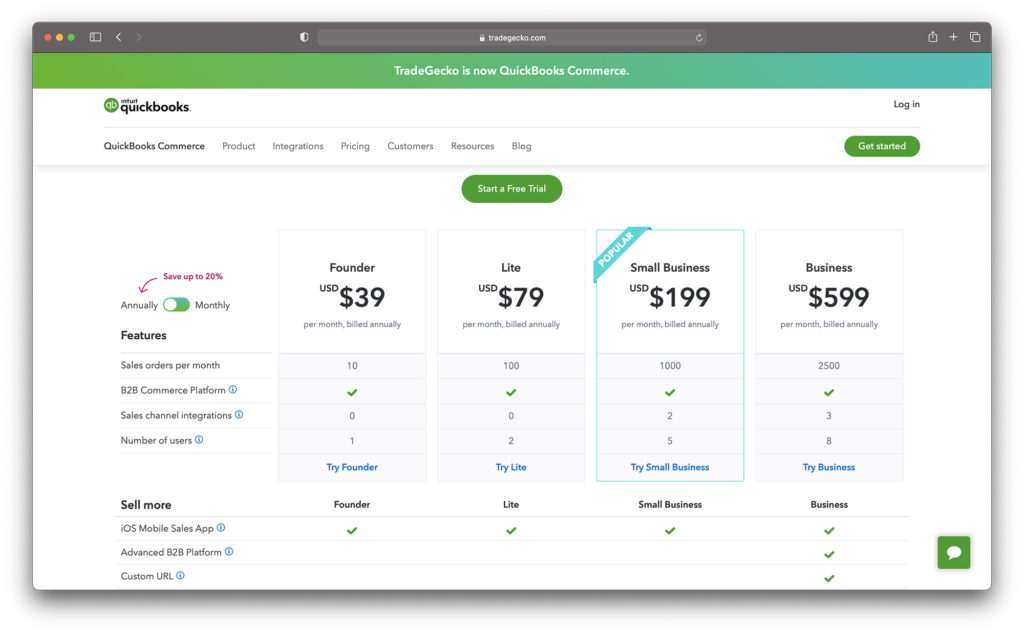
There are a total of 4 plans available for QuickBooks Commerce, and based on your needs, you may choose to pay annually or monthly. You will receive a small discount for making annual payments, typically up to 20% off your subscription. An annual purchase is typically a wise decision if you don’t mind being bound into the same program for a time. The plans are mentioned below:
- Founder: Starts are USD 39$ per month
- Lite: Starts are USD 79$ per month
- Small Business: Starts are USD 199$ per month
- Business: Starts are USD 599$ per month
The fact that each QuickBooks Commerce pricing plan includes a free trial is another crucial point to keep in mind. You can evaluate the services that QuickBooks Commerce can offer throughout the 14-day free trial period before spending any additional money.
9. SAP

SAP has flexible WMS software where a seller can manage a high volume of goods and run agile operations with digitized and accelerated warehouse processes. Its key features are:
- On-premise and cloud deployments
- Comprehensive WMS solutions
- Fully integrated quality, production and track-to-trace processes
- Real-time control of warehouse automation equipment
Pricing
SAP EWM for SAP S/4HANA Cloud’s pricing is communicated on request. It isn’t available on their website. They also have a disclaimer on their pricing page that “pricing information is subject to change and should not be considered an offer by SAP or its affiliates.”
Users can also ask for add-ons features for the WMS whose pricing might further increase. The benefits of those add ons are:
- SAP S/4HANA enterprise warehouse management via cloud deployment
- running with a variety of corporate management systems
- Most rapid time to value for new implementations
- Integrated warehousing solution
- Processes for quality, production, and tracking are completely interwoven
10. TECSYS WMS

Tecsys is a global supply chain solutions provider. It is growing with industry-leading services and tools to achieve operational greatness. It was incorporated in 1983 with its headquarters in Montreal, Canada. It has 600+ customers. It features a cloud-based system, the best system for medium and large organizations. It’s WMS software has received the Technology Innovation Leadership Award. Some of its features are:
- The streamlined inbound and outbound flow of Inventory
- Warehouse resource optimization
- Open and flexible automation connectors
- Easy deployment and onboarding
- Control in transportation management
- FIFO and batch control
Pricing
According to the kind and scale of the warehouse(s) to be handled, Tecsys WMS is a standard programme with three standard settings for webshops, wholesalers, and 3PLs, respectively.
Pricing hasn’t been mentioned explicitly on the website. However, various parameters considered in pricing are mentioned below:
- License/Subscription Cost: On-premise or cloud-based SaaS
- Maintenance Cost
- Implementation/Installation Cost
- Data Migration/Change Management Cost
- Recurring/Renewal Costs
What are the Features of WMS Solutions?

Inventory Management and Analysis
Many of the top WMS solutions include capabilities that enable businesses to gather data from warehouse operations. Companies benefit greatly from real-time tracking, especially when it comes to inventory management. This allows you to check your inventory levels in real-time, so you’ll always know whether you’re running out of anything or have too much stock in hand.
Other tools may filter data for KPI analysis, emphasizing areas where improvements are needed. Warehouse management software determines what is happening in a warehouse and where attention is required. Collecting high-quality data assists decision-makers in determining whether or not to make changes to important business processes, as well as in planning for the future.
Accurate and effective inventory tracking is one of the key advantages of RFID-integrated WMS. Individual items or entire pallets can have RFID (radio-frequency identification) tags affixed to them, and RFID scanners can automatically read the tags. Without the need for manual scanning or data entry, this enables warehouse employees to track the location and movement of inventory rapidly and accurately.
Tracking and Forecasting
This feature helps to increase customer satisfaction. A buyer before placing an order, checks the serviceability of their location and when it will be delivered. After placing an order, they get an estimated time of arrival (ETA) and can keep track of their order shipment. Sellers also track the order and can identify and correct any delays that crop up.
Due to the WMS’s ability to detect differences between the physical inventory and the digital record, RFID-integrated WMS can also aid in minimizing the chances of mistakes and inconsistencies in the warehouse. In addition to improving order tracking, RFID tags are used to trigger automated putaway and replenishment of SKUs, reducing the time and effort required for these tasks.
Order and Fulfillment Management
One of the primary WMS software functions is order and fulfillment services process optimization. WMS solutions help to improve order management by regulating the movement of a product through your warehouse. Users can utilize reorder features to automatically order components or products that need to be replenished on a regular basis. Some WMS solutions give users access to carrier networks, which can help them expedite branded shipping.
Warehouse managers can eliminate time-consuming human input chores as automation integration becomes more common. Incorporating robotics, artificial intelligence, and machine learning into WMS systems can significantly improve efficiency and speed. Picking robots can locate and move things without requiring workers to run back and forth between product and shipping regions.
Transportation Management
Though transportation management can be considered a different category in and of itself, WMS software frequently includes transport management system (TMS) functions. As an integral aspect of supply chain management, TMS software can directly affect and improve warehouse management. If you require transport management facilities, consider seeking a WMS software that includes it.
Labor Management
WMS solutions aid warehouse managers in monitoring worker performance through the use of key performance indicators. With this approach, workers who are doing poorly, as well as those who are performing amicably, can be readily identified. Warehouse Management System Software consisting of labor management can help identify your employees, keep track of their schedules, and assign duties to them. Employees can clock in and out using simple pins or fingerprints that keep track of their log-in and log-out time.
Types of Warehouse Management Systems
Depending on the size and nature of an organisation, there are four types of warehouse management software. Each comes with its own implementation method. They are:
- Standalone Systems
- WMS Modules in SCM Systems.
- WMS Modules in ERP Systems.
- Cloud-based WMS.
Each warehouse management software can vary in complexity also. While small organisations rely on simple hard-copy documents or spreadsheets, larger organisations require complex WMS systems.
Cloud-based Warehouse Management System
Like the most ERP systems, warehouse management system software also started with the use of on-premise servers. However, cloud has revolutionised the scene by introducing remote servers, thereby reducing the burden on organisations.
With a cloud-based WMS, the WMS vendor or a cloud service provider hosts and manages the software. Non-cloud managed service providers might also support warehouse management software, so IT departments in the companies don’t have to install, manage and upgrade warehouse management system software.
Cloud-based WMS systems are suitable for small and medium businesses (SMBs) who have budget restrictions. Also, independent servers may be redundant because of the scale of SMBs.
On the other hand, large-scale industries will benefit immensely with industry-specific customisation, specialised needs by deploying cloud-based WMSs.
Future of Warehouse Management
Cloud-based WMSs are the future of warehouse management. Among the best warehouse management systems, Oracle WMS cloud represents a paradigm shift. It offers the next-generation WMS system at an incredible value with innovative product features, mobile solutions, and a user-friendly interface.
In general, the benefits of cloud based WMS systems are as follows:
Increased Operational Efficiency: Use of cloud-based warehouse management software enhances supply chain visibility in real-time. This alignment with technology matches customer purchasing behaviours.
Lower Ownership Costs: Cloud-based WMS software companies decrease costs by eliminating expensive maintenance and upgrades.
Improved CX: Cloud-based warehouse management software allows purchases from anywhere at any time, meeting market demands. Faster fulfilment times enhance customer satisfaction.
What Businesses Would Be Best Suited for Warehouse Management Software?
WMS software is enabled with several facilities and gets updated and becomes smarter day by day. It is used in many industries to make their tasks easier and automated. These days, every company is using it according to their business size and complications. It can be customized for various types and sizes of businesses. Some industries use WMS solutions on a very high scale to efficiently run warehouse management processes. Some of them are listed below:
Manufacturing
Manufacturing industries have complicated warehouse requirements which makes WMS software an important tool for them. They deal in several types of products, materials and packages of varying sizes, volumes, rates, etc. Also, these items have different manufacturing timelines which needs to be segregated into pre-existing goods and newly created goods, and WMS solutions help to ease the process.
Wholesale Distribution

WMS software helps wholesalers to manage their complex supply chain and maximize accuracy. It allows them to utilize inventory space with exact quality deployment, fulfill orders faster, and manage multiple warehouses, combining cross-docking and advanced picking features.
Consumer Goods and Retail

You can observe that these days, there are multiple grocery stores that have a daily shortage of inventory and have hundreds/thousands of orders to fulfill across one city or in multiple cities. This complex management, if handled by humans, will increase time usage and have higher chances of inaccuracy. WMS solutions make it simple, and smooth and utilize resources at their highest level of efficiency.
Third-Party(3PL) Logistics Companies
Warehousing is a crucial operational function for a 3PL because its business is to manage the eCommerce logistics and orders of its partners. As a result, a 3PL always uses advanced WMS solutions. Most WMS warehouse management software providers provide packages tailored to the complicated structure of a 3PL warehouse, which must keep a multitude of items, owners, vendors, and order systems, distinct and working.
As they are in the business of eCommerce fulfillment, they use technology according to their partners’ needs, work models, and functionality by giving them personalized service. The 3PL can deliver reports and metrics of their sales, orders, inventory, etc, using WMS software. Customers can also manage data by generating customer-specific dashboards.
Hospitals and Health Care
This industry does not have a large inventory or a huge number of orders to fulfill although there are several factors like special storage conditions, a limited shelf life, requirement for 100% accuracy, ultra-fast delivery etc. and if any mistakes occur, it could result in the loss of lives. Here a single piece/item can affect the reputation of a seller, manufacturer and any person related to it.
What are the Benefits of WMS Software Solutions?
Optimizes Space and Lowers Operating Expenses
Warehouse Management System Software utilizes the floor space and reduces the amount of empty space. Through technology, it optimizes the area and the dimensions of products that are kept there. It keeps track of every item’s entry and exit and the actual space left in the warehouse.
Material rotation can also be aided by WMS solutions, whether through First-In, First-Out (FIFO), Last-In, First-Out (LIFO), or First-Expired, First-Out (FEFO) procedures. The WMS software can assist with any rotation rule that is desired. LIFO allows for the most efficient utilization of space and mobility. Product quality can be maintained by using FIFO or FEFO to keep products from expiring in the warehouse.
Increases Visibility of Inventory
Warehouse Management Software enables sellers to have an exact count and check inventory levels. It shows in real time, the product count, colour, size, holding period, etc. Features in WMS software to calculate the MOQ and EOQ can help sellers to predict when they will be short of inventory so that they can reorder again with the minimum inventory cost.
Increases the Effectiveness of Labor
A big or a small business should always take care of the utilization of its resources in the best possible way. The WMS software helps you gauge the potential of your workforce, keep them involved in the right direction and evaluate them on a day-to-today basis and throughout working hours.
Optimizes the Supply Chain
The WMS software can suggest the nearest warehouse to either the manufacturing unit or areas of high demand if a seller is using multiple warehouses. It optimizes and tells the seller about cross shipments to reduce logistics cost and timing. This helps in segregating the product batch right from picking and packing to the last mile delivery option. A better supply chain will give a more personalized touch to the buyer at the same time.
Auditing of Internal Automation
You as a businessman always need to keep auditing your business and also compare it with others or yourself in different periods. Due to lack of time and resources, you may do it once in a while but with WMS solutions, you can easily do a holistic audit of your business regardless if it is tangible or intangible.
Conclusion: Why is WareIQ’s WMS the best Warehouse Management Software for eCommerce Fulfillment in 2026?
After getting in-depth knowledge about WMS software (best warehouse management system) and its functionality, you as a seller are at the point to choose your partner for warehouse management to get all the benefits and services and achieve growth in your business. It not only reduces the need for resources but also utilizes them to keep their performance on track, guiding them to work accurately. For such tasks, WareIQ has user-friendly Warehouse Management Software. Its WMS is customized and created for eCommerce businesses so that they can perform all warehouse-related tasks in a single location which reduces complexity.
WareIQ acts as an aggregator for all businesses of all sizes and provides multiple benefits to its partners. Apart from the mandatory benefits that come under WMS software, it provides extra real-time features to their customers that help them in growing their business.
A few of the unique benefits are:
- A single platform for multi-channel sales fulfillment
- Smart picking and packaging services
- RTO Shield to reduce RTO expenses
- Smart MOQ & EOQ calculators for smart warehouses and multiple warehouses
- Smart inventory management

WareIQ is one of India’s leading and fastest-growing full-stack eCommerce fulfillment companies that offers a variety best fulfillment services from same-day and next-day delivery, shipping badges, RTO Shield, state-of-the-art technological solutions such as our custom WMS and our intuitive, well-designed app store. We can take care of your brand’s entire fulfillment requirements and ensure that you and your customers get the best order fulfillment in the country and have a hassle-free experience and raise satisfaction levels to new heights.
- Pan India Fulfillment & Darkstore Network: Plug-and-play fulfillment infrastructure with no minimums, which is compliant with Amazon Seller Flex, Flipkart Assured, Myntra and other marketplaces
- Inventory & Network Planning Excellence: Best-in-class AI models for sales forecasting, product segmentation, and inventory management to reduce inventory by 40% and increase revenue by 10%.
- Vertically Integrated Fulfillment Tech Stack: Our Fulfillment Tech Solution supports integrations with 20+ top marketplaces & D2C platforms, and prominent national, regional and hyperlocal couriers, enhancing reach by covering deliveries for 27,000+ pin codes
- Supply Chain Productivity Applications: Integrate a host of supply chain productivity apps with a single-click to your existing CRMs, ERPs & accounting software to manage your logistics workflows from one command center. Use Apps like RTO Shield to get 100% RTO protection, Branded Tracking to turn your order tracking page into a profitable marketing channel, and many more.
Trusted by 300+ top Indian brands, we are helping them accelerate online sales and expedite their growth through a synergistic combination of advanced technology, robust fulfillment infrastructure & seller enablement services!WareIQ is backed by leading global investors including Y Combinator, Funders Club, Flexport, Pioneer Fund, Soma Capital, and Emles Venture Partner.
WMS Software FAQs


